Local Living-Room Play · 2–4 Players

Shared-screen titles for living rooms

When everyone sits in front of one television, software ergonomics matter as much as game mechanics. Good couch co-op keeps eyes on the same focal point, eliminates menu bottlenecks, and turns physical proximity into part of the rules.

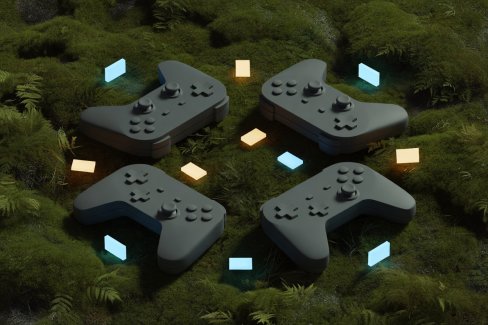
Four simplified isometric gamepad shapes and shared screen markers on dark olive moss
01 — Camera Rules That Hold Groups Together

Fixed stages, rubber-band zoom, and dynamic split-screen

Nothing derails a living-room session faster than a camera fighting over which player to follow. Games built specifically for local rooms solve this in one of three clear ways, and picking the right model depends on how your group moves through space.

Fixed-frame arenas—such as the kitchens in Overcooked! All You Can Eat or the obstacle courses of Rayman Legends—keep the entire playable field visible at once. Nobody gets dragged off-screen into a hazard, and spotting a teammate falling behind takes a fraction of a second. When players need vertical or horizontal scrolling, titles like Castle Crashers gently lock boundaries until enemies clear, giving stragglers breathing room.

For three-dimensional worlds where two friends must explore separate corners of a room, dynamic split-screen remains the gold standard. It Takes Two keeps both halves locked side-by-side so each person solves their own spatial puzzle while glancing across the seam to coordinate switches. Portal 2 relies on the same split-pane clarity, adding an on-screen ping icon so you can point at a wall without standing up to touch the television.

02 — Control Loops Built for Shared Screens

Two-player synergy versus four-player chaos

Two-player couch co-op works best when roles interlock tightly. In It Takes Two, almost every chapter hands one partner a complement to the other's tool—such as sap and matches, or magnets of opposite polarity—so neither person can coast while the other carries the level. In Portal 2, shared portal placement forces calm verbal timing before pressing a button.

Moving from two seats to four shifts the energy from quiet puzzles to fast arcade triage. Lovers in a Dangerous Spacetime drops up to four friends inside a single neon starship where guns, thrusters, shields, and the map sit in different rooms. You spend half the mission shouting across the sofa to swap stations before a wave hits your blind spot. Castle Crashers scales differently, stacking screen-wide brawls with simple combos and forgiving revive mechanics so someone unfamiliar with dual-stick cameras can join within thirty seconds.

Title Local Count Screen Model Core Shared Loop
It Takes Two 2 players Persistent split-screen Paired gadget puzzles and platforming
Portal 2 2 players Persistent split-screen Interlocking spatial physics chambers
Overcooked! All You Can Eat 1–4 players Fixed top-down stage Timed station handoffs and routing
Lovers in a Dangerous Spacetime 1–4 players Single ship view Running between helm, shields, and turrets
Rayman Legends 1–4 players Rubber-band 2D scroll Rhythmic jumping and bubble rescues
Mario Kart 8 Deluxe 1–4 players 2-way or 4-way split Accessible arcade racing with item balance
03 — Menu Friction and Gear Ergonomics

Eliminating pause-screen traffic jams

One overlooked flaw in local co-op RPGs is sequential inventory management. When only one player can open a skill tree or shop menu at a time, three friends end up staring at their phones for ten minutes every half hour. When testing a new couch title for your rotation, pay close attention to whether upgrades happen simultaneously or in shared quick-select wheels.

Controller parity is the second hurdle. Mixing unfamiliar third-party pads with asymmetrical layouts confuses button prompts, especially in rhythm or cooking games that flash colour-coded icons. Before guests arrive, pair every pad, check battery levels, and disable any automatic console sleep timers shorter than thirty minutes. If your group owns a Nintendo Switch alongside another living-room machine, keep games on hand that play cleanly on single sideways Joy-Con controllers—Boomerang Fu and Overcooked! All You Can Eat both thrive on minimal two-button schemes.

04 — Bridging Distance With Remote Couch Tools

When one regular moves away

Friend groups rarely stay in the same postcode forever. Fortunately, several local-first titles now support remote play streaming—where one host runs the game locally and friends stream video while sending controller inputs back over the internet—or include full online co-op alongside their couch modes. Tools such as Steam Remote Play Together let a single copy host titles built purely for shared keyboards or pads, provided the host has steady upload bandwidth.

When half the group is on a living-room sofa and one friend joins over voice chat from another city, choose games that offer hybrid local-plus-online lobbies. Mario Kart 8 Deluxe and Overcooked! All You Can Eat both let two people share one screen locally while linking up with remote friends online, keeping the old living-room rhythm intact without forcing everyone into separate solo booths.